
An experiment with wild fibers
This is a souvenir project of sorts (of which I neglected to take any pictures except of the final product). During my holiday this spring, I was walking around a lake, with its beautiful shaded shore, when I saw a linden branch lying on the ground, already half decomposed, the bark all fallen off. So I did what any normal person would do and picked it up.
This is a trick I learned from Sally Pointer's YouTube channel: the bast fibers of linden bark are long and can be used for cordage. After harvesting, the branches are left to ret in water for a little while, which makes it easy to separate the bast from everything else. I remember this from school playgrounds: little twigs often fell from the linden trees planted in the middle of the playground and, after a few days, especially in our humid Brittany climate, the bark was ready to slip off, making it immensely satisfying to peel.
Now, this branch I found had probably fallen from the tree some months before, so it had retted naturally and probably quite a bit past the ideal point for fiber manipulation. Doesn't matter; it's a first try, even subpar fiber will work. So when I got back to our lodgings (an 1813 house with stone walls a meter thick), I sat down outside, in the sun that had finally started shining, and proceeded to play with my new toy. I discarded the very shortest of the fibers as well as what was left of the rough outside bark, and split the long, still intact bast fibers into thin strands. They were somewhat brittle and very dry to the touch, probably due to the overdue retting situation. Still fun.
I got home with a little paper bag of prepared fibers, which then sat on my desk for a few months. It's only today that I've gone and made it into a length of cord. I sat in the garden with videos playing, which tells me that it took somewhere between an hour and a half and two hours to go through the whole pile. This is the result.
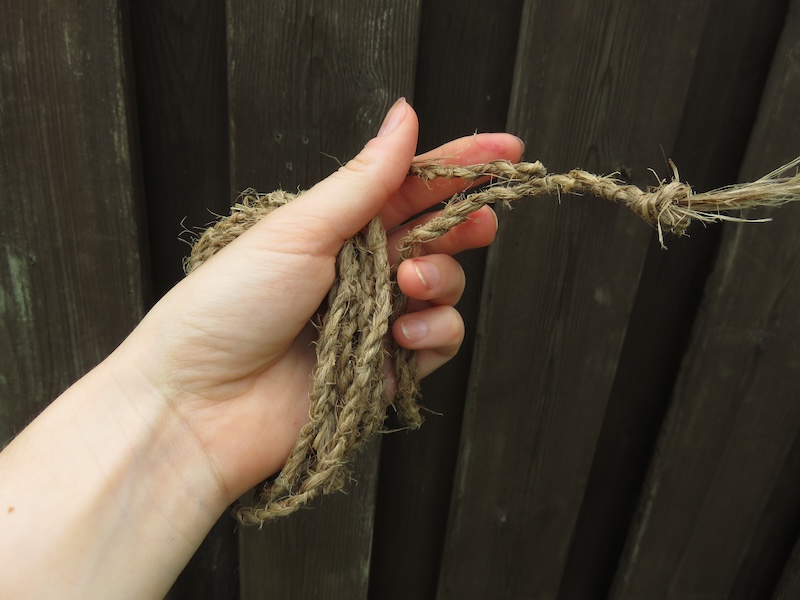
Visually, it's rough, and to the touch, even more so. The fibers themselves are coarse and dry, and I suspect the tensile strength of this cord is not very big. The most challenging part, I've found, was to apply twist evenly. I had to let the cord hang a few times so it could untwist itself. I think I didn't twist the plies enough compared to the twist between them.
Interestingly, I got a lot more length than I expected. Out of that single branch, of which I discarded at least half the material, I got well over three meters of cordage, which add up to about eleven grams. This makes it an interesting calibration exercise for future attempts. There will, of course, be more of those. I've yet to find the bandwidth to mess with nettles and brambles, but there is flax growing in the garden right now, so you best believe I'm going to have fun with it. With controlled retting, this time.
Comments